
Technology
How is this possible scientifically?
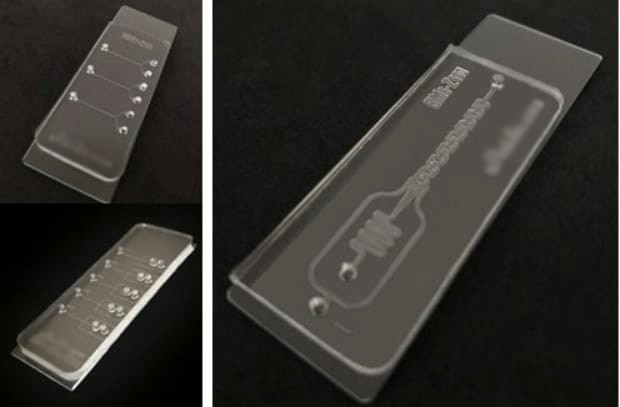

Microfluidic chips enable the precise and uniform encapsulation of fragrance droplets, resulting in consistent and controlled release over time.
Microfluidic reactors are easy to fabricate, and they function as tiny facilities for producing each microparticle one by one.
Both enabling small-scale and providing the same quality at high-throughput production of microcapsules, microfluidic chips make it a standardized and low-cost operation system, resulting in the lowest possible purchase price.
Here you can see one of the Scanning Electron Microscopy (SEM) images of Ottocaps® particles. Encapsulated fragrance in micron size ensures a large surface area for efficient and rapid release when triggered (e.g., by friction or heat). For more images and other supporting experiments, please feel free to contact us.
Having each microcapsule nearly identical in size leads to very uniform fragrance release, avoiding weak or overpowering bursts and giving a consistent scent experience.
Uniform and micron-sized capsules also distribute more evenly in products like fabrics, lotions, or detergents, improving performance and consumer satisfaction.
Encapsulated fabric softener fragrances should be biodegradable to avoid the accumulation of microplastics in the environment after washing and wastewater release.
Our biodegradable microcapsules break down into harmless substances such as CO₂, water, and biomass in soil or water, preventing long‑term pollution and ecological harm.
According to the restriction of microplastics announced by ECHA, several sectors have transitional periods: rinse-off cosmetics until 2027, detergents and fertilizers until 2028, plant protection products until 2031, and make-up and nail products until 2035, but they must have labeling of “This product contains microplastics” from 2031. So, the industry must have its solution for this restriction, and at this point, we might be your partner for biodegradable encapsulated fragrances